
How Matomo attributes traffic sources and conversions
Matomo tracks how visitors arrive at your website and attributes goal conversions and ecommerce orders to marketing channels. However, the channel that brings a visitor to your website does not always receive credit when that visitor converts. Understanding this distinction helps you interpret acquisition and conversion reports accurately.
This guide explains how Matomo classifies acquisition traffic and attributes conversions, including how Multi-Channel Attribution provides additional reporting options.
Acquisition and conversion attribution
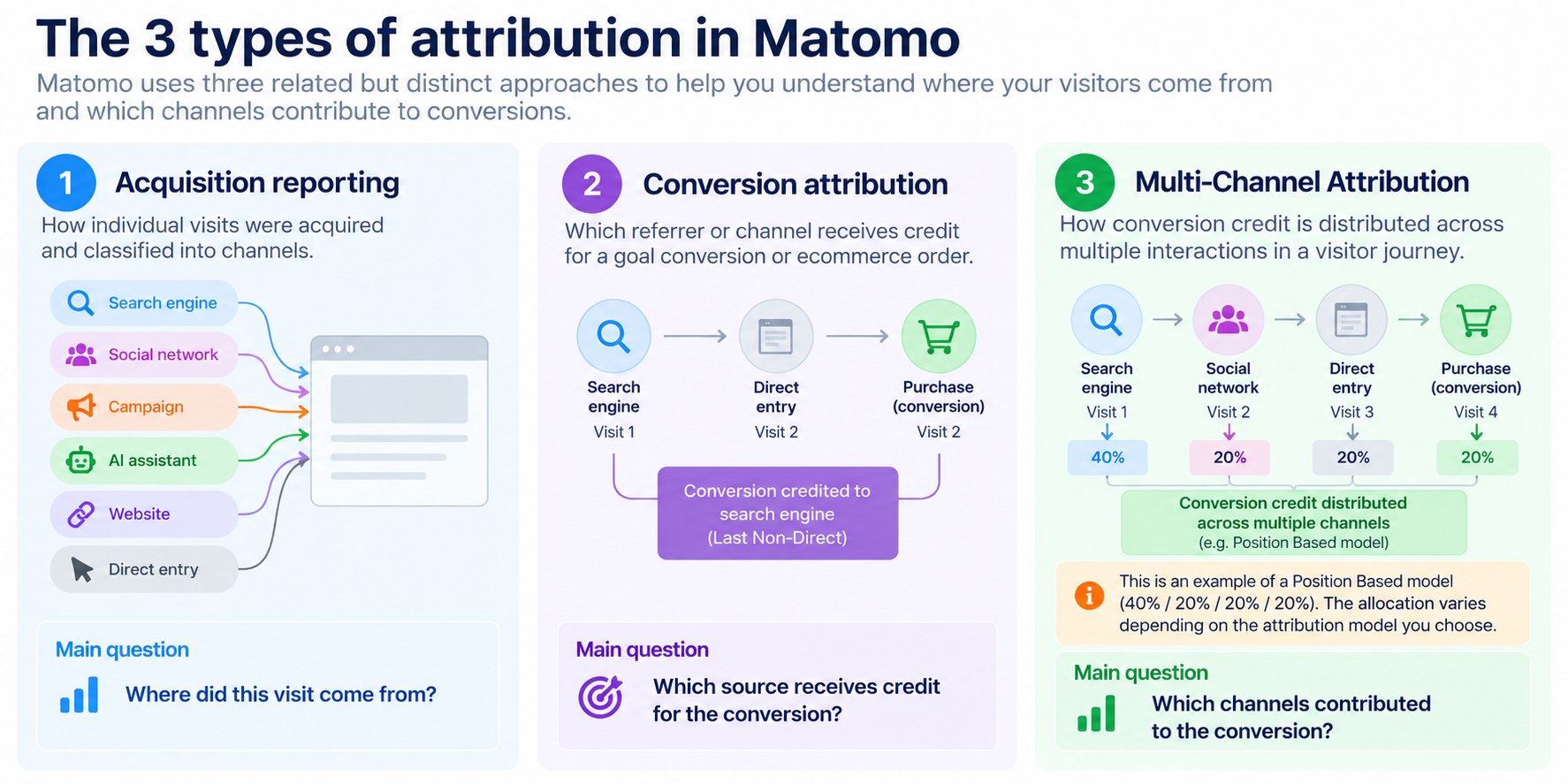
Matomo provides three ways to understand where website traffic comes from and how marketing channels contribute to conversions.
- Acquisition reporting shows how individual visitors arrive at your website and are classified into acquisition channels. It describes the source of each visit and does not necessarily determine which channel receives credit if the visitor converts later.
- Conversion attribution determines which referrers or channels that receive credit for a goal conversion or ecommerce order. By default, Matomo uses the Last Non-Direct attribution model for conversions.
- Multi-Channel Conversion Attribution shows how conversion credit can be distributed across multiple interactions in a visitor’s journey.
Why attribution reports may show different results
Acquisition, conversion and Multi-Channel Conversion Attribution reports can show different results because they classify visits or assign conversion credit in different ways. For example:
- Different attribution sources: A visitor may return directly and complete a conversion, while the conversion is credited to an earlier non-direct source.
- Different conversion credit: Standard conversion attribution generally credits one source, while Multi-Channel Attribution models can distribute credit across several interactions. This may result in fractional conversions or conversion value being reported for individual channels, even though the underlying conversion occurred only once.
- Different reporting conditions: Results can also depend on the selected attribution model, eligible interactions, available visitor history, lookback period and report scope. By default, Matomo’s referrer attribution cookie retains attribution information for six months, while Multi-Channel Attribution uses a separately configurable lookback period.
These differences do not necessarily indicate a tracking error. Reports may show different channel-level conversion numbers or values because they use different attribution methods or reporting conditions.
1. Acquisition reporting
When Matomo records a visit, it uses the available tracking information to determine which acquisition channel the visit belongs to. The acquisition channel identifies where a visit came from, while conversion attribution determines which source receives credit for a conversion. Depending on the information available and your tracking configuration, Matomo may consider:
- The referring website or URL, if it is available to Matomo.
- Campaign tracking parameters, such as
mtm_campaign,utm_campaignandutm_source. - Recognised search engines, social networks and AI Assistants.
- Configured website URLs and aliases.
- Referrer exclusions and other tracking settings.
Note: Visits recorded before the AI Assistants channel was introduced (Matomo 5.5.0, October 2025) are not automatically reclassified. Historical visits from AI Assistants may still appear under another previously assigned acquisition channel.
Acquisition channel precedence
A visit may contain multiple acquisition signals. Matomo evaluates the available acquisition signals in a defined sequence to determine which channel receives the visit. The illustration below shows the classification sequence:
- Recognised AI Assistant traffic takes precedence over Campaign classification.
- If AI Assistants or Campaigns do not apply, Matomo evaluates whether a usable external referrer exists.
- Visits without an identifiable source are classified as Direct Entry.
- Other visits are classified as Search Engines, Social Networks or Websites according to the recognised referrer.
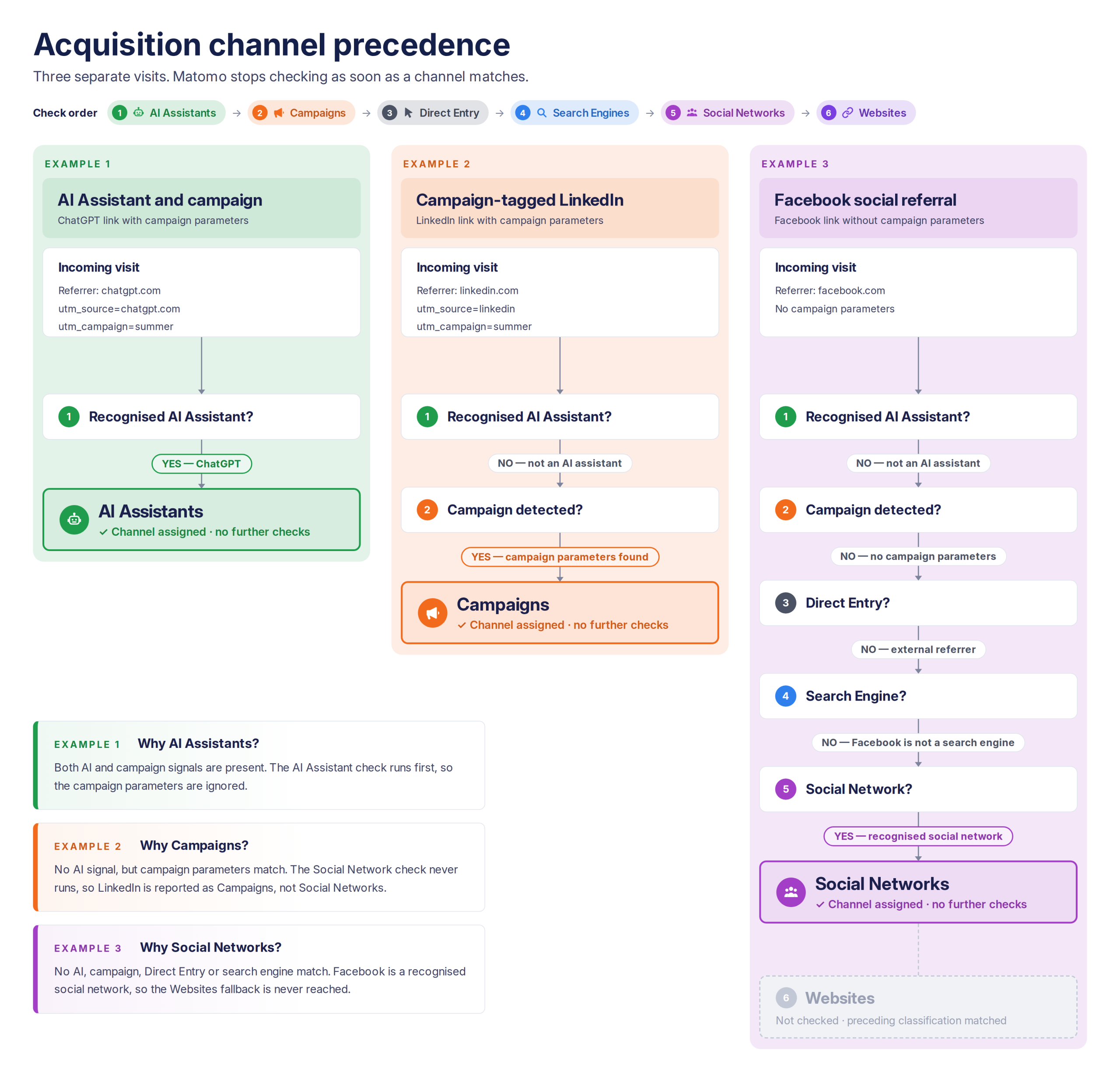
The final classification depends on the tracking information Matomo receives and the configured source-detection rules. Traffic from AI assistants and other AI-powered services may not always include a recognisable HTTP referrer.
Some visits may provide referrer information, while others may be identified through campaign parameters or recorded without an identifiable source. This can affect the acquisition reports as Matomo depends on the attribution information available for each visit.
Examples of acquisition channel classification
The following examples assume standard tracking configuration and successful source detection. It shows how different referrers and campaign tracking parameters affect acquisition channel classification. Each channel is assigned only when its detection conditions are met.
2. Conversion attribution
Acquisition reports show which traffic source brought visitors to your website for each visit. Conversion attribution determines which source receives credit when a visitor completes a goal or ecommerce order.
Referrers and returning visitors
When a visitor arrives at your website, Matomo uses available information, such as the HTTP referrer and campaign tracking parameters, to identify the traffic source and classify the visit into an acquisition channel. Matomo can also use first-party cookies to recognise visitors across multiple visits. This helps associate returning visitors with earlier activity.
For example, if someone arrives through Google search and later returns directly to complete a purchase, Matomo can attribute the conversion to the earlier search engine referral under the Last Non-Direct attribution model. If cookies or earlier attribution information are unavailable, Matomo may not be able to associate a conversion with a previous traffic source.
For more information, see How does Matomo detect unique and returning visitors?
Default conversion attribution model
By default, Matomo uses the Last Non-Direct attribution model for standard goal and ecommerce conversion reporting. This means Matomo generally credits a conversion to the most recent known non-direct source, such as a search engine, referring website or marketing campaign, even when the visitor returns directly before converting.
The following example illustrates how this works across two visits. It assumes Matomo can associate both visits with the same visitor and that the earlier attribution information is still available. If that information is unavailable, the attribution outcome may differ.
- Visit 1 from a Search Engine: A visitor arrives at your website through an organic Google search. Matomo identifies the search engine as the traffic source. The visitor browses the website but leaves without converting.
- Visit 2 as Direct Entry: The same visitor returns later by typing your website address or using a bookmark. Matomo recognises the returning visitor and can use the earlier attribution information. During this visit, the visitor completes a goal or purchase.
- Conversion attributed to Search Engines: Although the conversion occurs during the direct visit, Matomo credits it to Google search, the most recent known non-direct source.

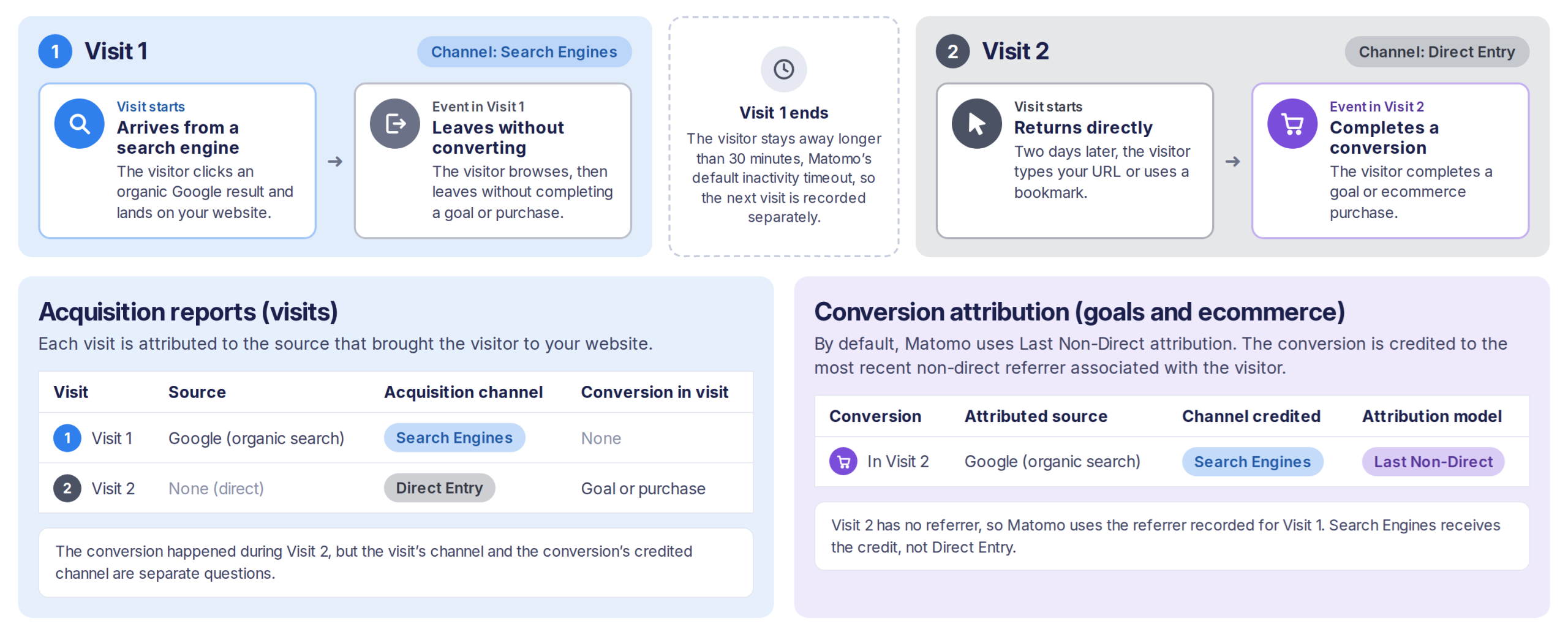
The two reports therefore answer different questions:
- Acquisition reports: How did the visitor arrive for each visit? Visit 1 is recorded under Search Engines, while Visit 2 is recorded under Direct Entry.
- Conversion reporting: Which source receives credit for the conversion? With Last Non-Direct attribution, Search Engines receives credit for the conversion completed during Visit 2.
For more detail, including how Matomo uses earlier attribution information, what happens when no previous non-direct source is available, see What is the default attribution model used in Matomo?
3. Multi-Channel Conversion Attribution
Matomo also offers Multi-Channel Conversion Attribution included in Matomo Cloud and available as a premium feature for Matomo On-Premise. It lets you explore how multiple interactions contribute to conversions using different attribution models.
Multi-Channel Conversion Attribution provides a broader view of the visitor journey than the default Last Non-Direct attribution by showing how different marketing channels contribute to conversions. Instead of relying on a single attribution model, you can compare how conversion credit is assigned across multiple interactions leading to a goal conversion or ecommerce purchase.
Matomo supports six attribution models:
Multi-Channel Attribution can produce different channel-level conversion figures because it uses the selected attribution model and defined lookback period to determine which interactions receive credit.
This does not mean additional conversions occurred. The same conversions are being evaluated using different attribution rules.
Attribution lookback period
The lookback period determines how many days before a goal conversion or ecommerce order Matomo looks for earlier interactions that may receive conversion credit. For example, a shorter period may exclude an earlier search engine visit that a longer period would include. Changing the lookback period can change which channels receive credit.
Changing the lookback period can affect which channels receive conversion credit, even when the attribution model stays the same. When comparing attribution models, use the same lookback period to ensure a consistent comparison.
The lookback is defined as Days prior to conversion in Administration  > System > General settings > Multi-Channel Conversion Attribution:

Access and analyse the multi attribution reports
When Multi-Channel Conversion Attribution is available, you can access reports in Matomo under Goals or Ecommerce > Multi Attribution. Select the attribution model, adjust the attribution period and apply segments to analyse particular groups of visits.
You can use these comparisons to understand which channels introduce visitors, which contribute along the journey, and which interactions occur closest to conversion. For setup instructions, feature availability and reporting options, see the Multi-Channel Conversion Attribution guides.
Attribution differences between Matomo versions
Matomo’s core acquisition classification principles remain consistent, although enhancements and updates can affect how traffic is categorised.
- A notable change was introduced in Matomo 5.5.0 (October 2025), with the addition of the AI Assistants acquisition channel. Recognised AI Assistant traffic takes precedence over Campaigns, including when campaign tracking parameters are present.
- When comparing acquisition reports across different periods, consider whether updates to channel detection or recognised traffic sources may explain changes in how visits are classified.
To investigate unexpected channel classifications, conversion credit or report discrepancies, see Troubleshoot differences between acquisition and attribution reports.