When social media first emerged, its main function in business was to drive traffic to websites. Now it’s a space where brands build relationships with their audiences and influence consumer decisions.
Deloitte’s 2025 State of Social Research found that 73% of consumers expect brands to respond on social channels and 71% want customer support there. However, only 41% of brands are meeting those expectations. So, where does your brand stack up? What impact does your social media marketing have on your customers?
Social media analytics can help you understand how engaged your audience is and where your strategy falls short. But, you need the right analytics tools for your team’s skill level, measurement needs and budget.
This article explores both dedicated social media analytics tools and other types of marketing analytics and reporting software to help you get more out of your social media marketing.
Key takeaways
- Social media analytics tools help businesses track engagement, brand sentiment and other metrics.
- There are dozens of options available today, ranging from comprehensive social media management tools to dedicated analytics platforms.
- Combining social media analytics with web analytics gives you a more complete picture of how people interact with your brand.
What are social media analytics tools?
Social media analytics tools are platforms that help teams analyze how well their social channels perform. They collect and analyze data from social platforms so they can answer questions like:
- Which campaigns are driving the most value?
- Is audience behaviour changing?
- What trends are driving change?
These tools also enable report creation and can suggest what to do next, enabling better and faster decision-making.
The best social media analytics tools in 2026
Here’s a closer look at the tools businesses and agencies use to analyse, report on and optimise social media performance.
Dedicated social media analytics tools
These tools only measure social media performance, but they do it well. They consolidate data from multiple social platforms, including Facebook, Instagram and YouTube, so marketers don’t need to switch between platform-specific measurement tools.
Sprout Social
Sprout Social is a comprehensive social media management platform that’s popular with brands and agencies.
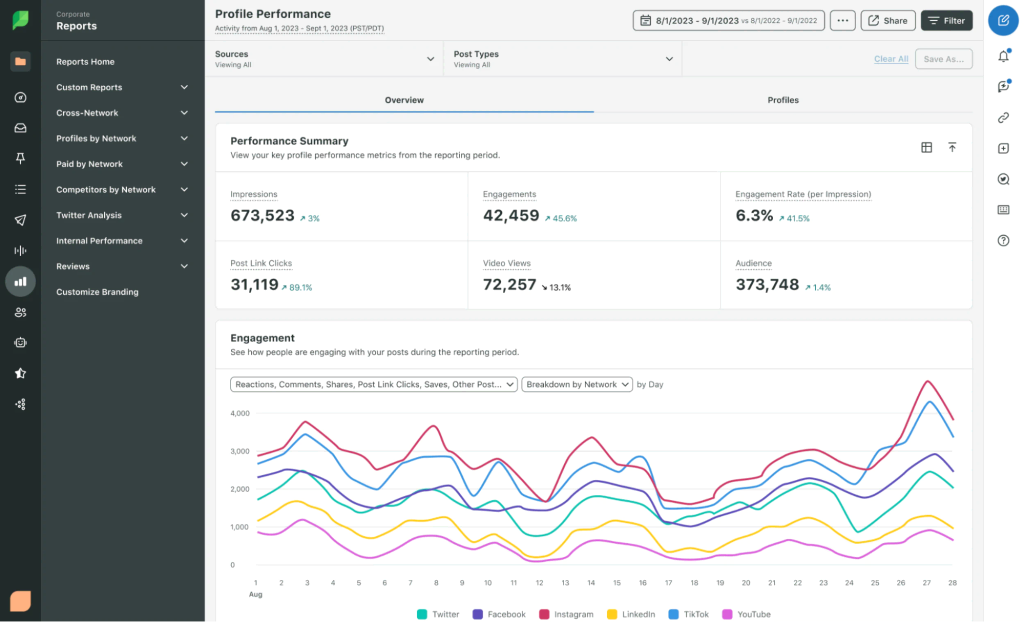
It has advanced features, including competitor analysis, social listening, CRM features and AI-enhanced responses. Sprout Social helps teams investigate how their brand is perceived on social with sentiment trend data and the ability to tap into real-time conversations. It also offers customisable metrics, making it easier to see how effective your social media marketing is in reaching specific campaign goals.
Additional platform support includes:
- Threads
- Bluesky
- Reddit (social listening)
- Tumblr (social listening)
Standout features:
- Smart Inbox offers unified message management across different social channels, including WhatsApp and Facebook Messenger.
- Social commerce capabilities link social activity directly to sales funnels, manage product catalogues for Shopify and WooCommerce and track sales performance.
Pros:
- Strong analytics and engagement features like group and post-level reporting
- Conversation history across profiles and networks for better context
- Integrations with Tableau, Salesforce, Marketo, Hubspot, Zendesk and more
Cons:
- More expensive than other options ($199/seat/month USD starting point)
- Social listening is paywalled as an add-on feature
Agorapulse
Agorapulse is built around inbox management, scheduling and ROI reporting. It’s a strong option if you’re looking for social media management features along with analytics.
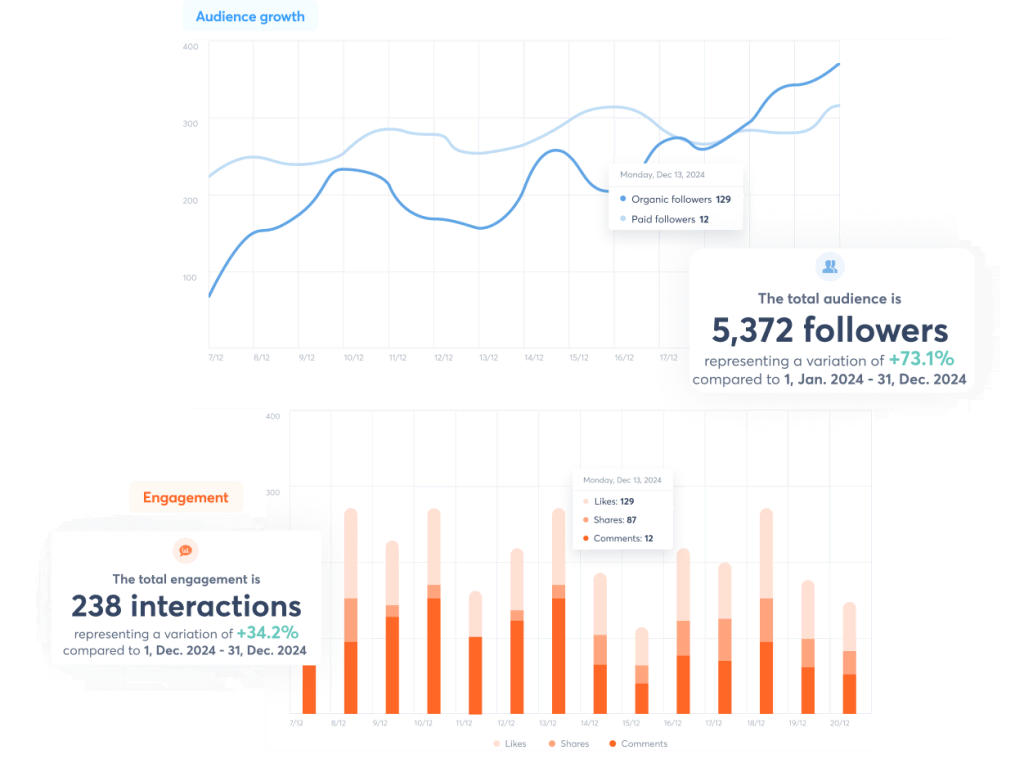
Its key differentiator is a built-in social ROI dashboard that ties social activity to Google Analytics conversions and revenue.
Standout features:
- AI-powered report digest gives you a summary of key results.
- Competitor posting tracking lets you see what keywords, hashtags and content are performing best and on which days.
- A built-in assignment feature routes posts or complaints to team members for review and follow-up.
Pros:
- Clean, intuitive interface
- ROI attribution at a cost-effective price point
- Less expensive entry price of $79/user/month USD
Cons:
- No LinkedIn competitor tracking
- Advanced features, including advanced ROI analysis, require the Advanced plan ($149/user/month USD)
Keyhole
Keyhole enables teams to improve social media campaigns and content strategy in real time. It’s primarily a social listening tool, so metrics focus on engagement and sentiment.
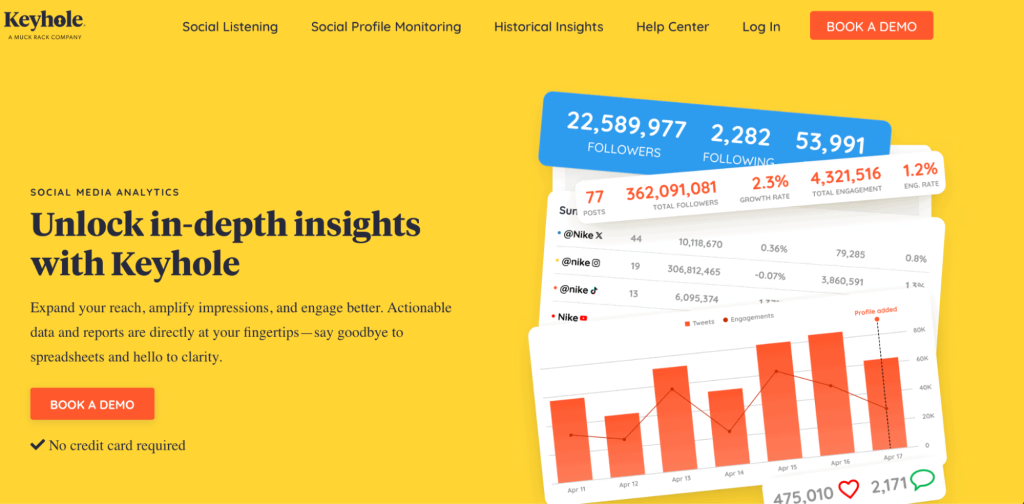
It can track the performance of plain posts, pictures, videos, stories and hashtags.
Standout features:
- Hashtag and keyword tracking enable you to identify past performance and spot trends.
- Influencer analytics reveals how much engagement influencer-specific posts are bringing.
Pros:
- Real-time hashtag monitoring
- Easy API integrations with internal systems
- Custom-branded report sharing
Cons:
- Only includes analytics
- Pricing information is only available upon request
Hootsuite
Hootsuite is one of the most popular social media management tools. It combines social listening features, such as real-time customer feedback analytics, with trend data and competitor analysis tools.
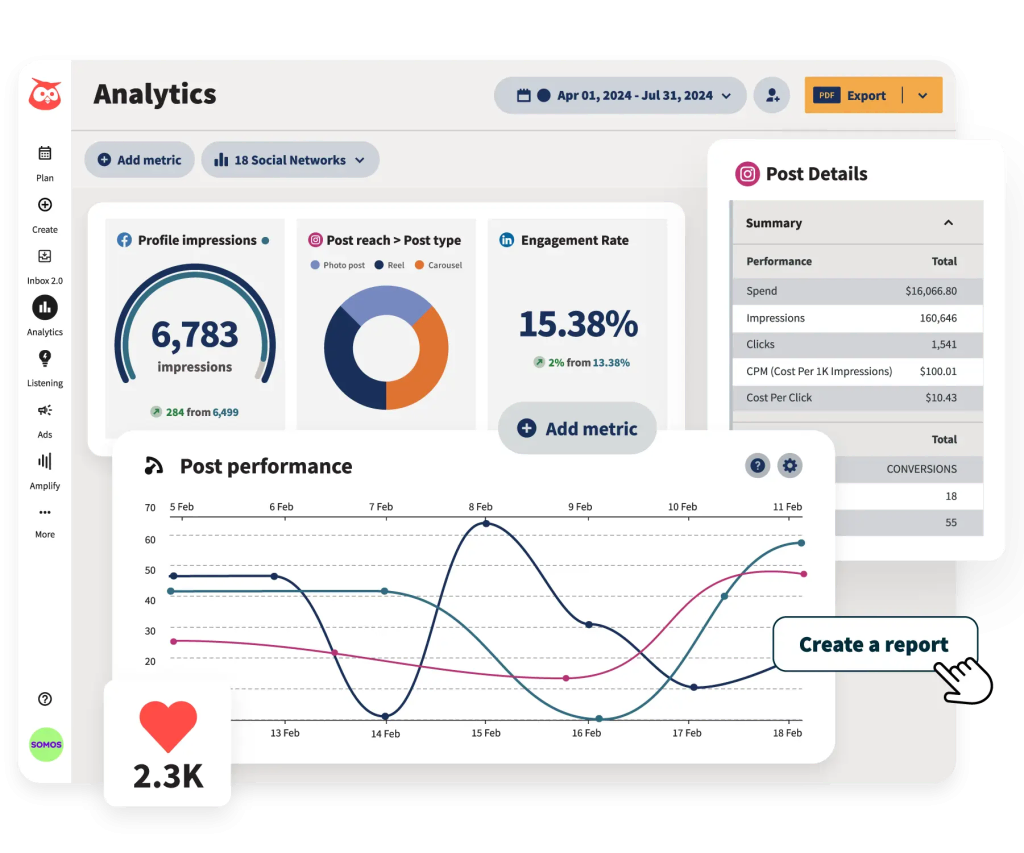
Hootsuite also has AI insights to help you forecast future trends and track real-time sentiment across social media.
Additional platform support:
- Threads
Standout features:
- Talkwalker’s Blue Silk AI is built into the platform for enhanced social listening, including trend forecasts and data summaries.
- Custom analytics dashboards with hundreds of performance metrics let you conduct granular analysis.
- It has the largest integration library with 100+ connected tools.
Pros:
- Pre-defined reporting templates for newer users to acclimate to the platform
- Up to 60% discounts for nonprofits
Cons:
- High pricing at $199/mo/user USD for the entry-level plan, which lacks the customisable reports and bulk uploading
- Steep learning curve
Other analytics tools for gaining a wider view of the customer journey
The following tools widen the lens, giving you insights into social media advertising performance and how social activity impacts other channels, such as website behavior.
Metrics Watch
Metrics Watch simplifies marketing reporting for agencies. It’s focused on Google Analytics reporting, but you can also connect with social media ad platforms to measure campaign performance.
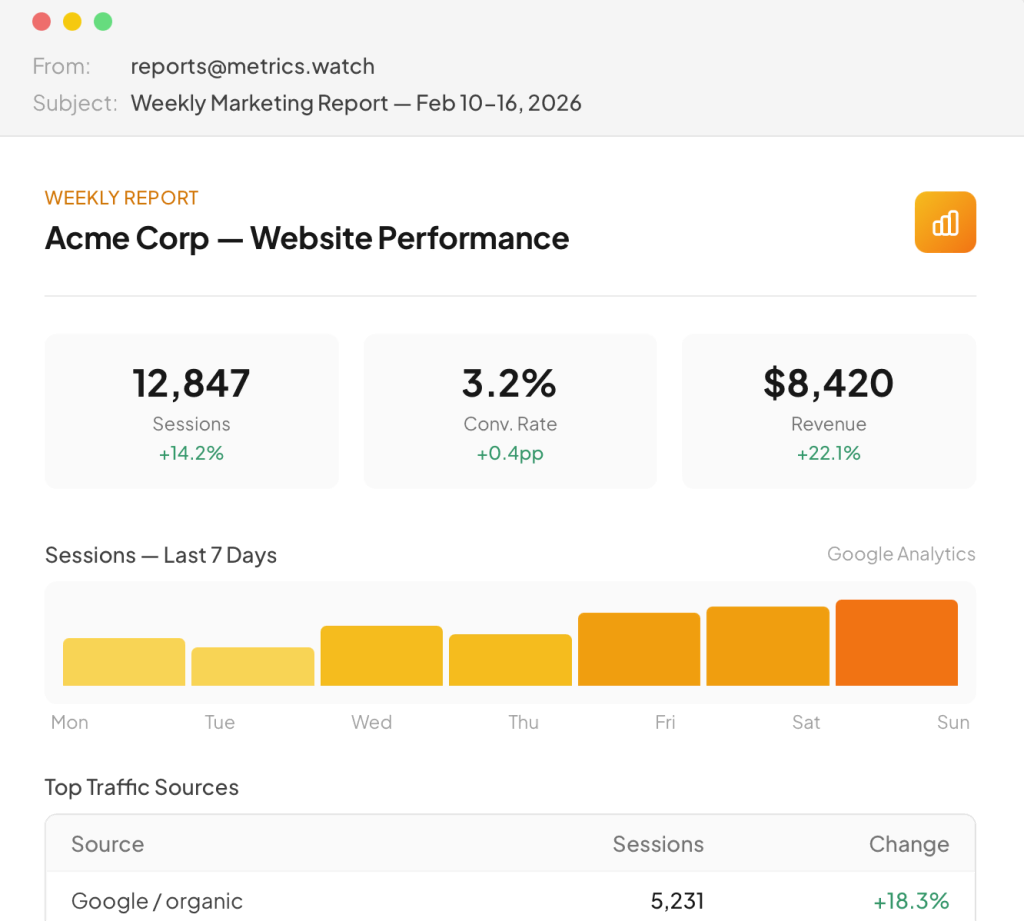
Metrics Watch collects data and sends it via email to clients automatically, making sharing reports simple.
Standout features:
- Automated email reporting delivers reports on social and marketing KPIs directly to client inboxes.
- Real-time analytics monitoring checks GA4 data every 5–10 minutes and alerts teams instantly when tracking breaks or traffic drops.
- Flexible alert configuration allows teams to set quiet hours and route performance alerts to the right person via Slack.
Pros:
- Report setup in under five seconds
- Free GA4 health scan detects tracking issues
Cons:
- Primarily performance reporting
- Lacks engagement and sentiment analysis
- Pricing scales for the number of alerts you want
Twilio Segment
Twilio Segment is a customer data platform. It focuses on unifying customer data across channels to help you personalize marketing. It pulls in data from social media, apps and more.
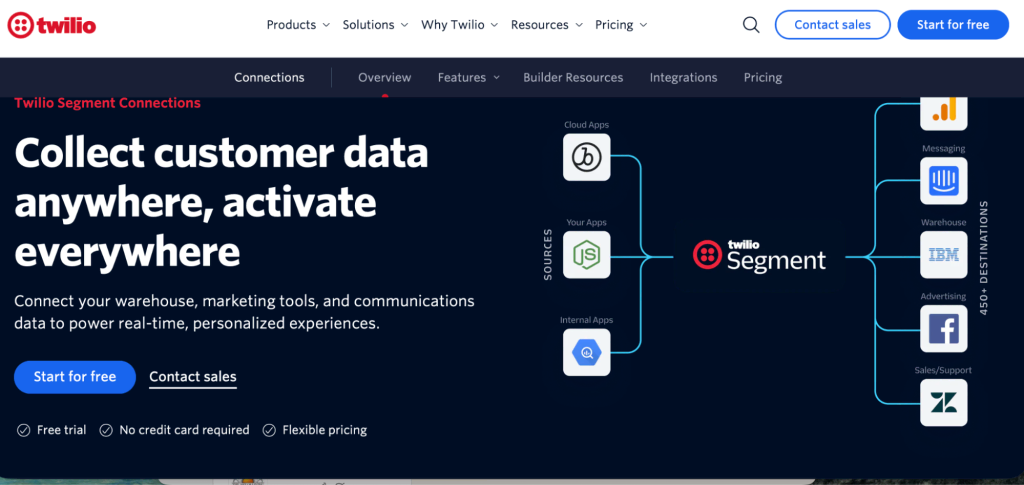
This tool gives insights into how social media activity connects to user behaviour and conversions.
Standout features:
- Collect and unify first-party data and send it to 550+ destinations.
- Flexible APIs and integrations let you build the right customer data architecture.
- AI-powered audience building and real-time customer journeys enable better personalization.
Pros:
- Extensive ecosystem with 700+ integrations including sources and destinations
- Centralised data governance improves compliance and control
Cons:
- Requires developer configuration
- Building data pipelines and configuring destinations may delay quick adoption
Built-in social media platform tools
Most major social media channels offer their own analytics. These tools offer accuracy, accessibility and platform-specific insights.
- Accuracy: You get reliable numbers that show how your content performs in that particular social media environment.
- Accessibility: They’re free. Anyone with an account can easily access them without needing additional software or paying extra for basic performance data.
- Platform-specific insights: Each platform provides audience insights tailored to its unique environment. On TikTok, for instance, you’ll learn how your content performs in their For You algorithm. While on Instagram, you’ll get a deeper understanding of the reach of your Stories.
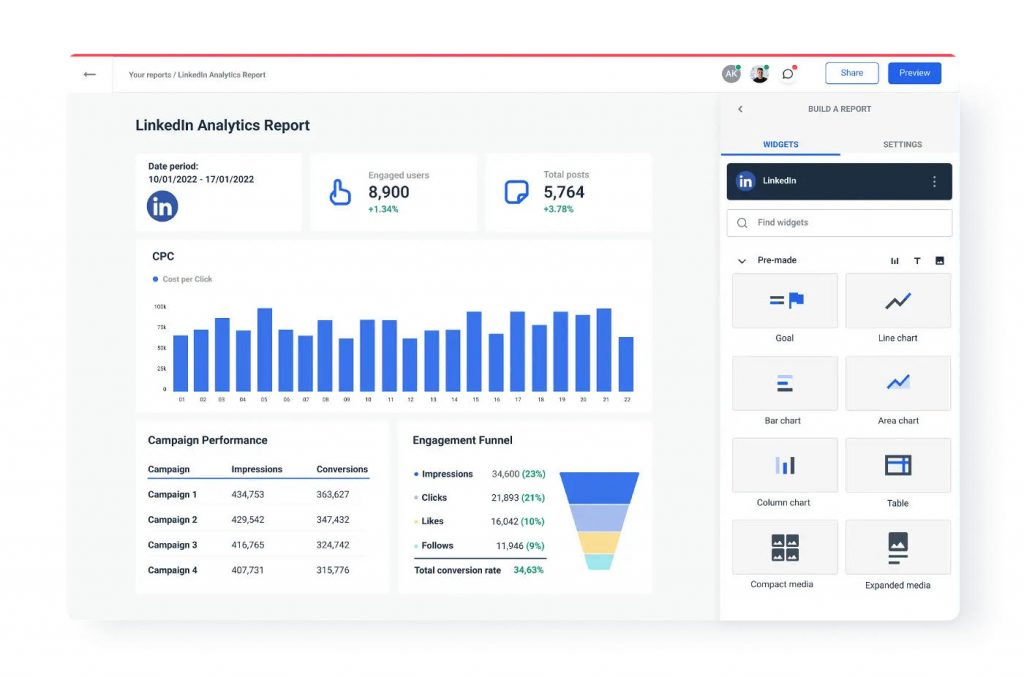
However, using platform-specific analytics tools on their own can cause problems.
- Siloed data: The analytics data remains within each platform, so you can’t compare channel performance without centralising and unifying the data.
- Limited historical data: Social platforms delete historical data for their own reasons and on their own schedule. For example, Twitter/X restricts historical data access to paid, enterprise-level customers. Even with a paid account, you’re still not in control of when your data disappears.
- Basic insights: Most platform-native tools lack the depth to connect social engagement to outside web- or app-based actions and revenue.
- Privacy concerns: Major platforms rely on tracking technologies, which is a problem for businesses that must follow stringent privacy regulations and laws.
Here are some of the key metrics first-party tools measure by platform:
- Facebook Insights provides information on post engagement and reach rates. It also offers audience demographics and tracks page growth.
- Instagram Insights shows the performance engagement metrics of various content formats, from Stories to Reels to live videos. It lets you compare unique account reach to total impressions and track changes in follower numbers.
- X (Twitter) Analytics tracks user engagement and total tweet/post impressions. It also provides data on profile visits and any changes to your follower acquisition patterns.
- LinkedIn Analytics offers the usual data on page views, metrics and content performance. But its greatest contribution lies in follower demographics, which are crucial for understanding a business audience. It also shows competitor performance data.
- TikTok Analytics provides information on the volume of video views and the crucial watch time metric. You can also see precisely where the traffic comes from and segment your audience demographics.
- YouTube Analytics provides valuable insights into overall watch time, viewing trends and subscriber growth. Most importantly, it measures audience retention rates, which serve as a strong indicator of how effective the content is.
Web analytics tools with social media features
Web analytics platforms don’t analyse activity within the social tools, but they can measure what happens after a user clicks a post and lands on your website or app.
Most of these tools can track:
- Referrals: Web analytics platforms automatically identify which social networks refer the most visitors to your website. Your analytics might reveal that Instagram drives more website visits than LinkedIn.
- Detailed campaign attribution: Web analytics tools also allow you to tag social media campaigns with Urchin Tracking Module (UTM) parameters. This helps you build URLs that can be attributed to particular campaigns while also identifying the source of responses.
- Goal and conversion tracking: Tools like GA4 and Matomo help marketing teams define and track social media share goals and other on-site conversions. This gives them a measurable link between engagement on social media and tangible business outcomes. Good examples are lead generation and content downloads.
- Segmentation: Tools like Matomo can also create visitor segments based on social network sources to analyse behaviour and engagement patterns.
- Funnels: With this feature, you can visualise how social visitors progress through multi-step goals, identifying drop-off points and opportunities for optimisation.
Web analytics let marketing teams see that a LinkedIn post got fewer clicks than Instagram, but recieved more demos, helping teams understand which campaign was more valuable.
The main advantage of these tools is their site-centric view. They reveal conversion paths and the effect of social engagement on website activity. For this reason, most teams use web analytics platforms alongside dedicated social media analytics tools, combining in-platform performance insights with post-click behaviour.
However, they don’t access social platforms’ APIs directly. While web analytics tools lack direct integration, you can deploy tracking tags, such as Facebook Pixel or LinkedIn Insight Tag.
Matomo
Matomo is a privacy-focused web analytics tool that tracks website and app analytics.

It helps you understand what users do on your website after coming there from a social media post link.
Standout features:
- Social traffic tracking via UTM parameters connects campaigns to website performance.
- Real-time visitor analytics shows behaviour from social channels.
- Privacy-first data collection gives you full ownership and control.
Pros:
- No data sampling in reporting
- Works without relying on third-party cookies
- Cloud and self-hosting options
Cons:
- Doesn’t measure platform-specific engagement metrics
Privacy and compliance:
- Support for GDPR compliance with consent management
- IP anonymisation options
How to choose the right tool
There are dozens of social media analytics tools to choose from, so how do you make the right choice for your business? The biggest clue is in those last two words: your business.
Take a structured approach and assess each tool based on the most important features or capabilities for your brand or agency. There are several factors to consider during the process:
- Define organisational goals: Clarify what you want to achieve on social media. What’s your focus? Brand mentions and awareness? Lead generation? Conversions? Whatever the answer, the tool you choose should measure the KPIs that directly align with your goals.
- Review budget: Many open-source platforms are free to use. For teams with the engineering resources needed for setup and configuration, they’re worth considering before committing to a paid tool.
- Determine “must-have” features: Understand the difference between basic social analytics and advanced capabilities. For example, follower count and engagement rate are relatively basic metrics. But social listening, competitor analysis, content publishing and AI insights can help you gain a deeper understanding of the customer journey.
- Consider team size and expertise: The platform must be intuitive enough for your team to use effectively from the start. Complex tools require training and time. When possible, look for ease of use and a low barrier to entry for daily analysis.
- Shortlist potential platforms: Decide which social networks are important to your social media strategy. A tool with strong integration and deep reach into your primary channels is more valuable than one that offers shallow support for many channels.
- Prioritise data ownership and privacy: For many organisations, having full control over data is critical. This is especially true in highly-regulated industries. Be sure to carefully review each tool’s official terms and policies on data storage and ownership.
Understanding the customer journey with the right analytics tools
Social media analytics tools allow organisations to refine their digital marketing strategies and connect and engage with audiences. By tracking engagement, referrals and conversions, these tools give teams the insights needed to optimise strategies and make informed decisions.
Pairing your social media tools with Matomo provides a comprehensive, privacy-first view of the entire customer journey. That extends from the first social interaction to the final conversion on your website.
You don’t have to take our word for it, though. You can try Matomo for free for 21 days (no credit card required).
FAQs
What are the big 4 of social media tools?
The big four social media tools refer to Facebook, WhatsApp, Instagram and YouTube by global user base.
What are the 4 types of analytics?
The four types of analytics are:
- Descriptive analytics: Summarises past performance, like how many new followers were gained in the past month
- Diagnostic analytics: Explains why something performed well or poorly
- Predictive analytics: Uses past trends to analyse future results
- Prescriptive analytics: Recommends actions to improve outcomes
Can ChatGPT analyse social media accounts?
ChatGPT can’t directly access social media accounts, but it can analyse performance if you feed it the right data. It can interpret trends, explain results and suggest ways to improve content.
What are the four main types of social media tools?
The four main types are:
- Image sharing platforms: Focus on photos and other visual content, like Instagram and Pinterest.
- Video sharing platforms: Enable users to upload and watch videos: think YouTube and TikTok.
- Social networking tools: Let users connect, build communities and share updates. Examples include Facebook and LinkedIn.
- Discussion forums: Help users ask questions and discuss topics. Reddit and Quora are examples.
What are the five pillars of social media marketing?
The five pillars of social media marketing are:
- Strategy: Defines goals, targets, audience and overall direction of your social media efforts.
- Engagement: Focuses on interacting with your audiences with comments and messages.
- Content creation: Involves producing videos or stories to inform, entertain or inspire audiences.
- Advertising: Uses paid promotions to expand reach and attract new users.
- Analytics: Measures performance to verify what’s working and what can be improved.